mi茅rcoles, 19 de abril de 2023

Describing Learners

Hey everybody, welcome again! 馃憢馃懡 

And just like that we reached the end of register 2, as well as the last entry... for now. 馃懟

This last topic was a bit short but still interesting. It is about the types of students, for example, if we want to teach something we must know who our "audience" is, we must know what they are good at, their preferences, and their strengths. 

Some aspects to consider as educators are age, their differences as learners, their language level, motivation, and their backgrounds.

Age: This is a very important aspect because depending on their age you will be able to decide on a teaching method. For example, children are creatures that are excited about learning new things, but they must be fun to capture their attention. Teenagers are like a middle ground, as they know how to behave and focus on activities with the goal of learning more, rather than having fun. And adults tend to be disciplined and mature, learning with the help of their experiences and expectations of their learning process may make the process easier. 

Learner's differences: Each person has his own way of learning, as well as have better developed some kind of intelligence and attitude. With the help of VARK and KOLB, their learning characteristics could be identified.

Language Levels: Students are also classified according to their language level. In case of the English language, it can be classified with the help of CEF (Common European Framework). Basic level is A1, A2; Intermediate level is B1, B2; and advanced level is C1, C2. This is very important because it helps to determine what skills they have with the language, and educators can give them the right classes to help them move forward. 

Motivation & Background: Of course, motivation is very important to learn, students should have clear goals of why they are learning something, this way it will be easier to be aware of what they study and commit to the learning process. On the other hand, their background is also crucial because that serves us as educators to be aware of where they come from and their situation, and thus avoid offending our students in any way.

Thank you for making it this far! See you next time and good luck with the midterms! 馃挅馃挮

martes, 18 de abril de 2023

馃摑 Learning Styles 馃摎

Hello again everyone, I hope you had a great vacation and are ready to continue learning!馃挭馃 


Today I am going to talk about Learning Styles and the difference between this and Multiple Intelligences... Basically, learning styles are ways or methods that suit us, we use the way we feel comfortable, and also where we can express ourselves, understand better and it is easier to remember the information. This means that learning styles are ways or methods we prefer to use to learn, however, multiple intelligences are the abilities that each individual possesses by nature.

There are 4 predominant learning styles: Visual, Auditory, Read/Write, and Kinaesthetic (VARK)
Visual: Visual learners understand and retain information best by seeing. They would prefer to see information presented in a visually appealing way, rather than in a written format.

Aural: Aural or auditory learners tend to learn information best by hearing it. Rather than getting actively involved in a class or writing out notes, they prefer to listen to others present the information and then are usually able to recite that back to them.

Read/Write: Reading and writing learners benefit most from reading and writing about new information. 

Kinaesthetic: kinesthetic individuals learn best by practically touching and doing things. 

Here are my results on the VARK test:


Kolb's and their learning styles: Kolb’s theory focuses on the learner's personal development and perspective. 

1 - Diverging (Feeling and watching)
2 - Assimilating (Watching and Thinking)
3 - Converging (Doing and Thinking)
4 - Accommodating (Doing and Feeling)

Here is my result on Kolb Test: 


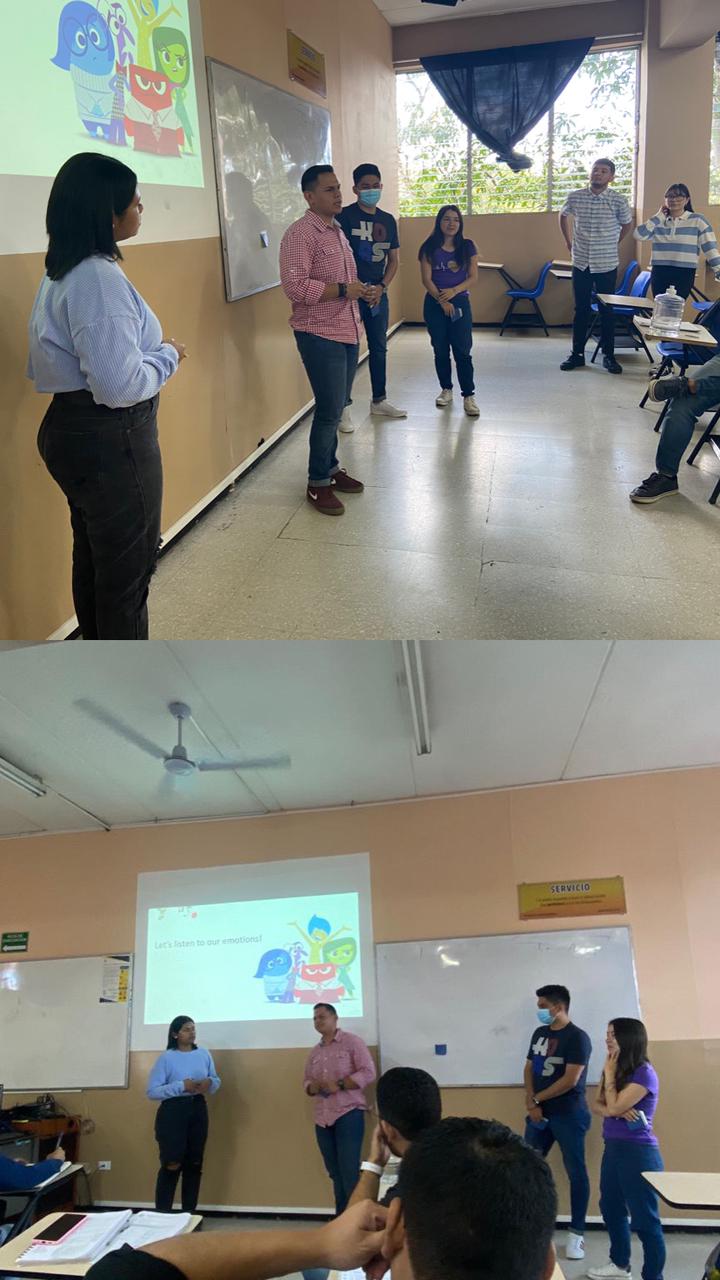
Finally, there was a presentation activity. We had to choose any topic from the ones we have seen in this register, and this one would help you think of some way to teach a topic, for example, what kind of activities would you do, demonstrating that there are different types of learning. 

Here are some pictures of some of the presentations, they were short but fun to watch.馃樃馃挮
(I put the last picture because my friend Andres looks funny, he was very happy to explain his topic)馃槀

Well, that is all for today, as always I hope you liked it and it will be a pleasure to see you in the next entry. Bye-Bye馃懟馃挀

jueves, 6 de abril de 2023

Multiple Intelligences presentations - Last Round

Hello again to my blog! Today I am going to continue talking about the presentations about multiple intelligences, so welcome to the last round! 馃懟

Group 6 - Intrapersonal Intelligence 

Well, this is my group it was formed by Andr茅s, No茅, Giselle, and Me, Alexia.✌ For this presentation as you can see, we all dressed in light blue shirts, as we thought it would be cute and cool.馃挋 

We talked about intrapersonal intelligence, its characteristics, and how we can develop it. This type of intelligence makes you connect more with yourself, know your emotions and feelings better, and know how to be at ease with your inner self. In addition, people who possess it tend to be independent and intuitive, they do not think things through but rather listen to their emotions. To develop this intelligence, activities can be done which are more reflective and meditative than physical.  

For our activity, we decided to do something that at first glance is simple but is important for this intelligence, and for this emotions were the main character! 馃槈 We ask three people to help us, so each of them would get in the front and pick a card on the whiteboard. Each card had a little face drawn, and they had to say out loud which emotion they thought it represented. Then, they would have to tell us a story where they experienced that emotion and answer some questions about how they felt and how they dealt with it. And, our prize was some notebooks to encourage them to start a journal or diary.  


Group 7 - Naturalist Intelligence


This group was formed by Eli, Nidia, Gustavo, Adriana, and Karla. They explained that this intelligence helps you to connect, categorize, and classify things with nature. Also, there are some characteristics of people with this intelligence and one of them is that they are in constant contact with nature. 

For their activity they played "What's in the box?" they asked 4 people to participate and 2 of my friends (Andr茅s and Giselle) participated, they had to play and guess what it was, as they guessed, and they won a pineapple and a lemon.  


Group 8 - Existential Intelligence 

Kenneth, Fer, Mauricio, and Jonathan group were the ones in charge of this intelligence. With this intelligence you have the ability to understand issues related to human existence, it makes you ask questions about life and its meaning, also about your own life.  

Finally, the activity required the entire class to participate. They made groups of 5 and did breathing exercises. Then they gave questions that had to be discussed as a group. 


Well, that's all about the multiple intelligences presentations. I wish I could have been there but I know we all did a great job. 馃挆

See you soon! 馃挜


lunes, 3 de abril de 2023

Presentations about Multiple Intelligences, Rounds 1 & 2

Hello, hello, hello again... 馃挘馃挜

For this entry, we have group presentations where each group was assigned one of the "Multiple Intelligences" which was my topic for the last entry. At the moment I will only talk about 5 groups as they are Rounds 1 & 2, the topics for these rounds are: Visual-Spatial, Logical-Mathematical, Bodily-Kinesthetic, Linguistic-Verbal, and Musical Intelligences.


Group 1 - Visual-Spatial Intelligence: 


This group is formed by Dani, Nathy, Miriam, and Maria. They talked about how with this intelligence you can have another perspective of things, it allows you to create mental images and detect details. They also mentioned that solving puzzles is a way to develop this intelligence. 

Then, they did an activity and asked for volunteers to make a group of 3, honestly, I was excited and I told my friends to participate and we did. 

The activity was about solving a puzzle called Tangram, we had to form a square with the figures they gave us, unfortunately, we didn't win ☹ and I think our problem was that we concentrated too much on two figures that we thought they were fine and we didn't keep arranging them in another way, but well, it was still a lot of fun 馃槉.


From this group onwards I could no longer be present at any presentation because I had a medical leave ☹ My friends told me what they did and shared some photos with me, it's a pity I wasn't there because I was looking forward to participating in another activity. 


Group 2 - Logical-Mathematical Intelligence


Round 2 started with group 2, "Logical-Mathematical Intelligence" which is formed by Herrera, Maru, Clarita, Katherine, and Damaris. Well, they explained that this type of intelligence helps to understand problems with a logical pattern. In addition, people with this intelligence tend to use common sense to make decisions. 

Then, they moved on to activities. The first was about a memory game, and the second was a word search. 
The latter is one of my favorite games, if I had been there I would have participated for sure. Apparently one of my friends did manage to participate and even won, what a lucky guy.

Group 3 - Bodily-Kinesthetic Intelligence

The people in charge of this intelligence were Abi, Josh, and Rodrigo. Basically, this intelligence is the ability to learn through physical movements.  They explained that people with this intelligence are usually good at working with their hands and can do many things like making crafts or building things with blocks or legos. 

The activity of this group was to play charades, to be honest, I am not a big fan of this kind of games maybe because I am not extroverted, but I would have liked to see the groups participate, I think I could have had fun.

Group 4 - Linguistic-Verbal Intelligence


Magaly, Diana, Eunice, Jaime, and Alisson group were in charge of this intelligence. With this intelligence you have the ability to use spoken and written language, so it helps to read and listen to podcasts. The advantage of this intelligence is that it helps to have a wide vocabulary, helps to learn new things, and of course, it has the ability to communicate. 

For the activity of this intelligence, they asked 5 people to help them test their vocabulary. Apparently, they had to match the word with its definition and look for mistakes in sentences and synonyms. 
It is an interesting game but personally, I don't think I would have participated, as I know my strengths and I know that this type of intelligence is not one of them. Here are the Top 3. 


Group 5 – Musical Intelligence


This last group of the day consisted of Christian, Joaquin, Josselin, Ivette, and Jessica. Well, with this intelligence you have the ability to have a good sense of music and rhythm. They are considered to have a good appreciation for music and find it easy to remember melodies, and songs, identify notes, and enjoy focusing only on music. 

I think this intelligence is one of the highest I have, I like music a lot, I work and study with it, melodies make me feel calm and it's like my comfort zone. Whenever I listen to music it's like I create a new scenario about anything (It's like "shh my show already started"). 

This group's activity was about guessing the song, they would play about 5 seconds of a song and those who participated had to guess the name and singer. Maybe I would have liked to participate, but after seeing the songs they played I don't think I would have guessed almost any of them since it's not the type of music I like.


Well, that would be all for this entry but not all the presentations, see you in the sequel. bye-bye 馃懡


jueves, 23 de marzo de 2023

Multiple Intelligences

 Hello everyone, and welcome again to my blog! 馃槑

Today's topic is "Multiple Intelligences". This theory about multiple intelligences was created by the American psychologist Howard Gardner, who proposed that people need to develop several types of intelligences. He points out that human beings have more developed and less developed abilities. He concluded that there is no such thing as "intelligence" itself, but that there are many more that are independent.

There are many types of intelligence, let's see what each one is about:  

  1. Linguistic-Verbal Intelligence馃憖: it is the ability to master the language and be able to communicate effectively. It not only refers to the ability to communicate orally but also in writing. This intelligence may be useful for politicians, writers, journalists, etc.
  2. Logical-Mathematical Intelligence馃拃: This type of intelligence is related to the ability to reason logically and solve mathematical problems. Scientists, economists, academics, engineers, and mathematicians usually excel in this type of intelligence.
  3. Visual-Spatial Intelligence馃挮:  Provides the ability to observe the world and objects from other perspectives. Ability to create mental images, and draw and detect details. In this intelligence, we find painters, photographers, designers, advertisers, architects, etc.
  4. Musical intelligence 馃帳: There are many types of music and this led Gardner to understand that there is also an associated intelligence. The brain executes functions linked to the interpretation and composition of music. Those who have this type of intelligence are, of course, musicians, those who are able to play instruments, read, and compose with ease. 
  5. Bodily-Kinesthetic Intelligence馃拑馃暫: This refers to the bodily skills needed to use tools or express certain emotions through the body. Those who possess this intelligence are dancers, athletes, and even surgeons. 
  6. Intrapersonal intelligence馃檹: It is the one that helps us to understand and control our emotions. It makes us able to access our feelings and reflect on them and helps us to maintain well-being in all aspects of life.
  7. Interpersonal intelligence馃懇‍馃懇‍馃懄‍馃懄: This is an intelligence that allows us to interpret words or gestures, or the objectives and goals of each conversation. It gives us the ability to detect and understand people beyond what our senses can perceive. Teachers, psychologists, therapists, lawyers, and pedagogues are profiles that usually score very high in this type of intelligence. 
  8. Naturalistic intelligence馃尶: Allows us to detect, differentiate and categorize aspects related to the environment, such as animal and plant species or phenomena related to the weather or things in nature. It is considered an essential intelligence for the survival of human beings.
Gardner says that all human beings possess the types of intelligence, but that some excel more in some than others and stresses that none is more valuable than the others. 

The teacher Orlando gave us a photocopy of the "Multiple Intelligence Wheel" first we had to do a little test and then color the wheel according to how many points we had in each intelligence. I will leave my results below, but as you can see I had the most points in "Visual-Spatial Intelligence"馃ぁ, which surprised me because I did an activity on that type and I couldn't solve it. I thought I would have more in musical or intrapersonal. But well, I will also say that my lowest score was in Logical-Mathematical Intelligence which doesn't surprise me because I am very bad with numbers.馃槤

Well, that would be all for now, I know it's a lot of information but it's very interesting too. Until next time, bye-bye. ❤✌

domingo, 19 de marzo de 2023

Collaborative Approach - Welcome Register 2!


Welcome to a new register, and also, to a new topic the "Collaborative Approach". As its name says, it is about doing collaborative work, it consists of making small groups carry out activities or learning tasks. It is procured that everyone participates and learns.

Some collaborative learning approaches put mixed-ability pairs, groups or teams together to work in competition with each other in order to drive more effective collaboration.

The Collaborative Approach is divided into three: 
  • Community language learning (CLL): This is the last topic of the past register, so, in short, this method is based on support, also called "tribe" to learn, its main characteristic is that there is nothing prepared, but it flows naturally.
  • Task-based learning (TBL): In this case, preparation is essential as activities are presented in the target language to build communication skills. Task-based learning has the advantage of getting students to use their skills at their current level, developing language through its use
  •  Content-based learning (CBL): The team is encouraged and students are able to complete any content-based task.
These are a few ideas of each that the teacher gave us in class:

Some of the activities that can be done are:
  • Listening triangles: Students make trios, in which each has a role, either the speaker, who asks the questions, and the other takes notes.
  • Talk partners: Students pair up to do a small discussion activity. 
  • Think-Pair-Shared: A topic is prepared to discuss with their partner and after they have discussed their thoughts, they go in search of another partner so they can share what they discussed.
Here are some photos from the first class on this topic.

Well, that would be all about my little explanation of the Collaborative Approach, I hope it was clear to understand. 馃挦 See you in the next entry, bye-bye! ✌❤

jueves, 2 de marzo de 2023

That's all - Bye Register 1

Hello again, fortunately, this time we will not be talking about theory but about how was the last class of the register and before the midterm馃槸


In the last entry, I mentioned in the last activity we were assigned was to explain one of the methods, my group had to talk about the Grammar Translation Method馃憦

The class began with the teacher assigning us between 20 - 25 minutes to prepare our posters and for the presentation. So that's what we did and once time passed we started to present, each group with their method and went on to explain the most important. Besides, these presentations were very useful for us because when we finished we all had a quiz about all the methods. 馃槺


So that's all we did in Register 1, it was very theoretical but at the same time dynamic register with the help of some methods, I hope I explained myself properly and I'll see you soon for sure! 馃槈❤